The Third Tale
  • Home
  • About
  • Search

The Heart Sutra

9/26/2012

1 Comment

 
Picture
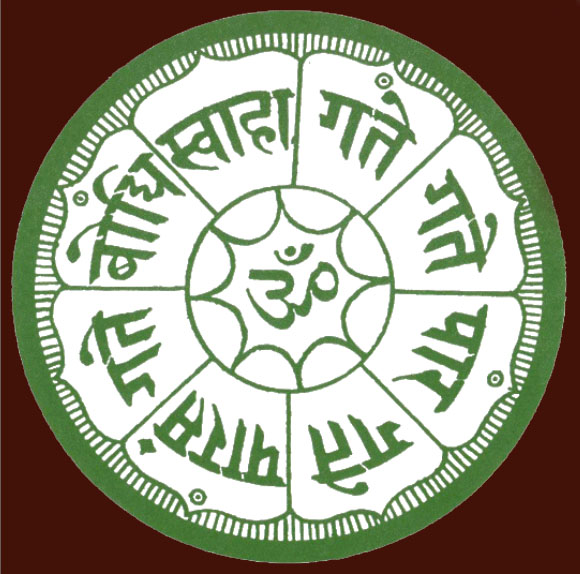
The Prajna Paramita Mantra in Devanagari characters
Here's the Heart Sutra as I chant it:

Maha Prajna Paramita Hridya Sutra

Avalokitesvara Bodhisattva
when practicing deeply the Prajna Paramita
perceives that all five skandhas are empty
and is saved from all suffering and distress.

Shariputra,
form does not differ from emptiness,
emptiness does not differ from form.
That which is form is emptiness,
that which is emptiness form.
The same is true of feelings,
perceptions, impulses, consciousness.

Shariputra,
all dharmas are marked with emptiness;
they do not appear or disappear,
are not tainted or pure,
do not increase or decrease.
Therefore, in emptiness no form, no feelings,
perceptions, impulses, consciousness.

No eyes, no ears, no nose, no tongue, no body, no mind;
no color, no sound, no smell, no taste, no touch,
no object of mind;
no realm of eyes
and so forth until no realm of mind consciousness.

No ignorance and also no extinction of it,
and so forth until no old age and death
and also no extinction of them.

No suffering, no origination,
no stopping, no path, no cognition,
also no attainment with nothing to attain.

The Bodhisattva depends on Prajna Paramita
and the mind is no hindrance;
without any hindrance no fears exist.
Far apart from every perverted view one dwells in Nirvana.

In the three worlds
all Buddhas depend on Prajna Paramita
and attain Anuttara Samyak Sambodhi.

Therefore know that Prajna Paramita
is the great transcendent mantra,
is the great bright mantra,
is the utmost mantra,
is the supreme mantra
which is able to relieve all suffering
and is true, not false.

So proclaim the Prajna Paramita mantra,
proclaim the mantra which says:

gate gate paragate parasamgate bodhi svaha
gate gate paragate parasamgate bodhi svaha.

--------
Here's an audio version

Categories: Buddhism, Spirituality
1 Comment

How to Live

4/22/2012

0 Comments

 
Picture
The Dhammapada is a widely-quoted collection of sayings of the Buddha. I read selections (almost) every day, and have learned some by heart.

The quote above is from Chapter 6, Verse 79. Actually, as the numbers are consecutive throughout the book, it is enough to say just "Verse 79"; but the chapters are thematic, and Chapter 6 concentrates on "The Wise."

It reads:
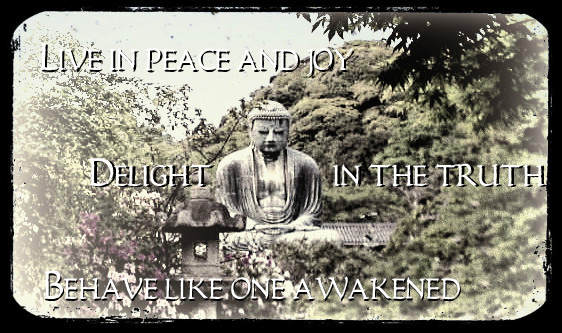
Live in peace and joy
Delight in the truth
Behave like one awakened
As for the picture, it's a heavily-manipulated version of an original photo of the Great Buddha of Kamakura, Japan. I was fortunate to visit it many times when I lived in Yokohama, and I have dozens of shots, so you'll be seeing him again. The outdoor location is dramatic, with the hills behind and the ocean in front (said to be good feng shui).

Categories: Art, Buddhism, _Japan, Peace, Photography, Quotations, Spirituality
0 Comments

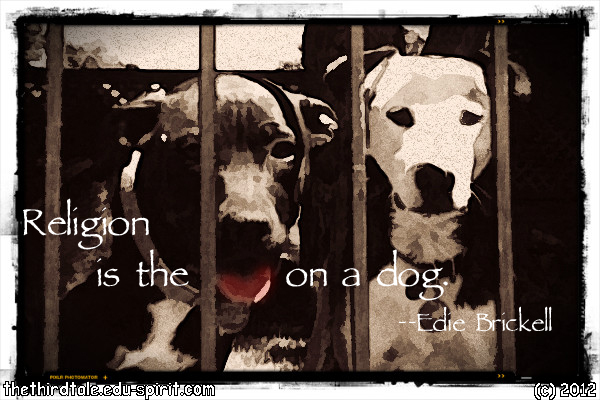
"Religion is the Smile on a Dog"

4/14/2012

0 Comments

 
Picture
Twenty-plus years ago, Edie Brickell (who is also Mrs. Paul Simon--did you know?) sang in "What I am":

I'm not aware of too many things,
but I know what I know if you know what I mean.
Philosophy is the talk on a cereal box.
Religion is the smile on a dog. (complete lyrics)

That last line was a topic of discussion at the time; was it a good thing or a bad thing?

Here's something Ms Brickell has said since (via Wikiquote):

In a world religion class, everyone was complicating life and existence by over-thinking. I had this sense it's right here, right now. It's who we are and what we feel. It's not this tangled web of psychology and philosophy. I was driving to band practice and started singing that song. I wanted to be real, not adopt some philosophy or role. Instinct is our driving force.

There you have it: instinct. We continually get our minds in the way, between what is and what we perceive. Dogs don't have this problem.

The two above were my teachers many years ago, around the time the song was popular. Ginger (the smiling one) was with us a short time, until one day she had a disagreement with a train. Buster (the serious one) was found on the street, and never lost his savvy. He died of old age on my ex-wife's farm in Tennessee.

In "The Hollow Men," T.S. Eliot wrote:

Between the idea
And the reality
Between the motion
And the act
Falls the Shadow
...
Between the conception
And the creation
Between the emotion
And the response
Falls the Shadow
...
Between the desire
And the spasm
Between the potency
And the existence
Between the essence
And the descent
Falls the Shadow
---

Could this intervention of thought between "out there" and "in here" be what Eliot means by "the Shadow"?

Categories: Bio, Buddhism, Mindfulness, Music, Photography, Poetry, Quotations, Spirituality
0 Comments

A Stone Girl Dancing

4/8/2012

0 Comments

 
Picture
Someone recently posted this on FaceBook, and it reminded me of a few poems.

First, a poem made up of various well-known Zen lines by Korean teacher Seung Sahn:

The Great Way has no gate.
Clear water has no taste.
The tongue has no bone.
In complete stillness, a stone girl is dancing.
--
That last line comes from an old ko'an (a Zen saying meant to break us of the habit of conventional "thinking"):

Zen Master: "When you hear a wooden chicken crow, you will understand your mind." What does this mean?
Student: "A stone girl dances to the music of a flute with no holes."
--
And both of these always make me think of the poem "Natural Music" by one of my favorite poets, the Californian Robinson Jeffers. (I don't know WHY I think of it when I read them, because the girl in the last line is not stone. I guess it's because she's dancing?) Anyway:

The old voice of the ocean, the bird-chatter of little rivers,
(Winter has given them gold for silver
To stain their water and bladed green for brown to line their banks)
From different throats intone one language.
So I believe if we were strong enough to listen without
Divisions of desire and terror
To the storm of the sick nations, the rage of the hunger smitten cities,
Those voices also would be found
Clean as a child's; or like some girl's breathing who dances alone
By the ocean-shore, dreaming of lovers.

--
Chewing on any or all of these will be time well spent. Enjoy.

Categories: Art, Buddhism, Facebook, Photography, Poetry, Spirituality, Zen
0 Comments

The Veggie Monk

4/6/2012

0 Comments

 
Last November, Lila and I had the pleasure of visiting Shaolin Temple, where my former student and good friend Venerable Yanti resides (though he was in Russia at the time--teaching English and kung fu to children!)
Picture
After visiting the main compound, we walked a short way to the "pagoda compound" (which I liked even better than the main temple). While we were there, this monk walked by with the veggies.

I wonder for how many centuries this same scene has been enacted on the same spot?

Categories: Art, Buddhism, China, Photography, Temples, Vegetarianism
0 Comments

Putting Lipstick on the Buddha

4/4/2012

0 Comments

 
It was a tough sorta day: I was hoping to do all three of my temples in Putian in a single marathon.

I had done Nangshan Cishou Si, then waited an inordinate amount of time to get a cab to take me to Guanghua Si. He had brought me in on a side-street filled with statuary workshops. After seeing the temple, I was rushing out to catch another cab to Guangxiao Si when I was captivated by the sights around me.
Picture
This shot is my favorite of them all, for that day and many days.

And oh yeah: I made it to my third and final temple of the day.

Categories: Art, Buddhism, China, Photography, Temples
0 Comments

Vairocana at Longmen

4/3/2012

0 Comments

 
A monumental statue of the Vairocana Buddha at Longmen Grottoes, Henan, China
Picture
Categories: Art, Buddhism, China, Peace, Photography, Temples
0 Comments

Some "Spiritual Cartoons" from FaceBook

4/3/2012

0 Comments

 
A few funny thought-provokers that I ran across.

The first is from 11:11 (FaceBook, homepage) via FB friend Letecia Layson:
Picture
The rest are from Sweeping Zen (FaceBook, homepage) via FB friend Hudoyo Hupudio, an Indonesian teacher of meditation (FaceBook, homepage):
Picture
Picture
Picture
Picture
Picture
Categories: Buddhism, Facebook, Humor, Mindfulness
0 Comments

More on Master Xuyun (虚云), "Empty Cloud"

4/3/2012

0 Comments

 
In a previous post, I mentioned the great 20th-century Chan (Zen) Master Xuyun. Here's a little more information about him.
Picture
Master Xuyun with his disciple Benhuan, subject of a previous post
There is a fairly active group of Chan (Zen) practitioners in the West who claim lineage from Master Xuyun, and they've published a number of things about him.One of his disciples, of the same vintage as Master Benhuan, was Master Hsuan Hua, who founded (among other things) the City of 10,000 Buddhas. He wrote a biography about Xuyun which can be found beginning here. It's quite long, and the navigation is a little tricky. Use the link like this "下一頁" in the upper right to move from to the next page. When you reach page 104, you'll need to go here to see 105.

It's well-worth a read, if nothing else for the picture it paints of Buddhism in China in the 20th century. I'm still trying to figure out what some of the place names are (I'm used to the Mainland, not the "Taiwanese," spellings), but the Chinese text helps a lot.
Picture
Master Xuyun in his old age
Picture
Master Hsuan Hua as a young man
If you want a shorter, more concise look at the Master's life, try Wikipedia; or this slightly longer one by Charles Luk.

Categories: Buddhism, China
0 Comments

Death of Master Ben Huan (本焕): The End of an Era

4/2/2012

0 Comments

 
Picture
An older photo of Master Benhuan
Picture
Master Benhuan in more recent years
The Chinese blogosphere and Buddhist community is mourning the passing of Master Ben Huan. He was born in 1907, so died at age 106 in the Chinese way of reckoning. An account of his life and death, in slightly fractured English, can be found at the Shenzhen Standard site.

I had never met the Master, though I had been in the same room with him a few times. He was most recently abbot at Hongfa Temple in my city of Shenzhen (though he retired a few years ago).
Picture
Master Benhuan meditating at Putuoshan in younger days
I believe I'm correct in saying that this Master was the last of the old-time monks, born, shaved, and trained before the formation of the New China in 1949.

The Master (whose name meant something like "illustrious roots") was considered a disciple of the great Xuyun (also spelled "Hsuyun," meaning "Empty Cloud"), about whom more in another post. But we can say here: "illustrious roots" indeed.
Picture
This poster, seen at Hongfa Temple when Master Benhuan was retiring in 2009, advertises the investiture of the temple's new abbot, In Shun (印顺), shown on the right of Master Ben Huan. To the left is the rather ghostly-appearing Master Xuyun.
BTW the photos of a younger Benhuan above are copies of some hanging on a wall in the tea room at "my" temple, Hongyuan Si. A subsidiary of Hongfa (and therefore also developed under Master Benhuan), it sits just 20 minutes from where I live.

Slightly-improved obit in the Shenzhen Daily (the paper for which I write): Part I / Part II

Categories: Buddhism, China

0 Comments

    Your Host:

    I've spent my life reading, traveling, writing, thinking. Wanna do it with me? (more here)


    Get this blog in your inbox!
    Enter your email address:

    Delivered by FeedBurner

    RSS Feed


    Find me on Facebook!

    Follow @JamesBaquet

    Follow Me on Pinterest


    Archives

    May 2013
    September 2012
    June 2012
    April 2012

    Categories

    All
    Art
    Bio
    Buddhism
    China
    Compassion
    Facebook
    Gratitude
    Humor
    Japan
    Karma
    Mindfulness
    Music
    Peace
    Photography
    Poetry
    Quotations
    Shakespeare
    Spirituality
    Sri Ramakrishna
    Temples
    The West
    Vegetarianism
    Zen

Powered by Create your own unique website with customizable templates.